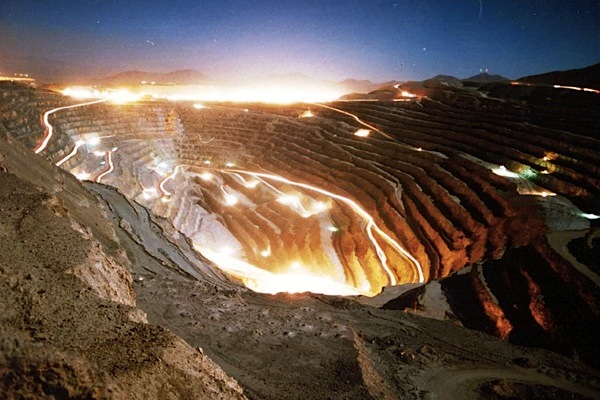
Quelle: bloomberg.com
Unabhängiger Blog über interessante Rohstoff-Stories, spannende Wirtschafts-, Politik- und Finanzthemen, das BIG PICTURE, den Kapitalmarkt, aussichtsreiche Investments, aktuelle und brisante Themen + Trends aus der Rohstoff-, Minen- und Energiebranche, sowie über sämtliche Faktoren, die auf den spannenden Rohstoff-Markt Einfluss nehmen. "The more I learn, the more I realize how much I don‘t know." (A.E.) | Always Do Your Own Due Diligence.
Posts mit dem Label Kupferpreis werden angezeigt. Alle Posts anzeigen
Donnerstag, 9. Juni 2016
Kupfer-Konsum, China: Energieerzeugung bleibt wichtigster Verwendungsbereich
Labels:
Asien,
Chart,
China,
Elektronik,
Energie,
Energiebranche,
Energiewende,
Industrie,
Industriemetalle,
Konstruktion,
Konsum,
Kupfer,
Kupferpreis,
Solar,
Strom,
Stromerzeugung,
Transport,
Trend,
Verbrauch,
Wind
Dienstag, 31. Mai 2016
Kupfer: Großer Nachfrage-Anstieg im Bereich der Erneuerbaren Energien erwartet
Der begehrte König der Industriemetalle kommt zunehmend bei den Erneuerbaren Energien zum Einsatz. Der weltgrößte Minenkonzern BHP Billiton (BHP) will davon profitieren und stellt einen Ausbau der Kupferproduktion in Aussicht. Hierzu ein aktueller Bericht von Bloomberg:
‘Real Spark’ for Copper Demand Is Renewable Energy, BHP Says
Renewable energy and China’s economic shift toward consumer-led growth will be major catalysts for a new wave of copper demand that’ll accelerate a shortage forecast to develop from 2019, according to BHP Billiton Ltd., the world’s largest mining company.
“The real spark, though, is the demand for renewables,” said Jacqui McGill, asset president for BHP’s Olympic Dam copper mine, the world’s fifth-largest deposit of the metal. “Regardless of where the energy’s coming from, it needs copper.”
‘Real Spark’ for Copper Demand Is Renewable Energy, BHP Says
“The real spark, though, is the demand for renewables,” said Jacqui McGill, asset president for BHP’s Olympic Dam copper mine, the world’s fifth-largest deposit of the metal. “Regardless of where the energy’s coming from, it needs copper.”
Labels:
Angebot,
Angebotsdefizit,
Ausblick,
Australien,
BHP Billiton,
Biomasse,
Energie,
Erneuerbare Energien,
Kupfer,
Kupfermine,
Kupferpreis,
Kupferproduzenten,
Nachfrage,
Olympic Dam,
Prognose,
Solarenergie,
Windenergie
Mittwoch, 18. Mai 2016
Kupferpreis fällt auf 3-Monatstief
Der Kupferpreis kommt nicht in die Gänge und steht erneut vor einer bedrohlichen Kursmarke..
Quelle: bloomberg.com
Labels:
Baisse,
Basismetalle,
Big Picture,
Chart,
Charttechnik,
China,
COPX,
Dollar,
Entwicklung,
Industrie,
Industriemetalle,
Kupfer,
Kupfermarkt,
Kupferminen,
Kupferpreis,
LME,
Rohstoffe,
Schwäche,
Trend,
Wirtschaft
Dienstag, 12. April 2016
Kupfer: Der besondere Boom-Bust-Zyklus
Hierzu ein informativer Beitrag von Reuters:
Investment in copper, a boom and bust cycle of a different kind: Andy Home
By Andy Home
LONDON (Reuters) - (The opinions expressed here are those of the author, a columnist for Reuters.) Do you remember JPMorgan's Physical Copper Trust..?
Investment in copper, a boom and bust cycle of a different kind: Andy Home
By Andy Home
LONDON (Reuters) - (The opinions expressed here are those of the author, a columnist for Reuters.) Do you remember JPMorgan's Physical Copper Trust..?
Quelle: stockcharts.com
Labels:
Baisse,
BHP Billiton,
Boom,
Bust,
China,
Codelco,
Freeport,
Hausse,
Hype,
Indikator,
Industrie,
Industriemetalle,
Krise,
Kupfer,
Kupferpreis,
Kupferproduzenten,
Rio Tinto,
Überangebot,
Wirtschaft,
Zyklus
Freitag, 1. April 2016
Kupfer: Enge Korrelation mit Chinas Einkaufsmanagersindex
Labels:
Asien,
Big Picture,
Chart,
China,
Daten,
Divergenz,
Einkaufsmanagersindex,
Entwicklung,
Historie,
Index,
Indikator,
Industrie,
Korrelation,
Kupfer,
Kupferpreis,
PMI,
Rohstoffe,
Vergleich,
Wachstum,
Wirtschaft
Dienstag, 29. März 2016
China: Kupfer-Importe legen deutlich zu
Die chinesischen Kupferimporte zogen im Februar um satte 20% an:
Shanghai copper inventories surge amid growing speculation
TOKYO - Record Shanghai copper inventories fed by speculative imports are obscuring the level of true demand in China, making the metal less reliable as an economic indicator.
Copper on the Shanghai Futures Exchange ended Friday at 37,620 yuan ($5,774) per ton, down slightly from Thursday and 5% below a recent high hit in early March. Data released after trading showed on-warrant copper inventories at 177,000 tons, marking an 11th straight weekly increase. That level is double inventories during March 2015.
"Arbitrage trading betting on a weakening of the yuan" is responsible for ballooning copper inventories, said Takayuki Honma of Sumitomo Corp. Global Research.
Investors predicting that the yuan will lose value are buying Shanghai copper in anticipation that yuan-denominated prices will rise. That demand has at times boosted the metal's Shanghai price above that on the London Metal Exchange. Shanghai copper traded at the equivalent of around $4,570 per ton in late January, compared with $4,440 in London. Copper traders began procuring the metal from warehouses in London and exporting it to China, keeping it in Shanghai for delivery, Barclays reports.
LME inventories have thus fallen 40% since the start of the year. China's copper imports, meanwhile, surged more than 20% on the year to 860,000 tons in January and February. That metal has not been consumed, instead becoming part of swelling inventories..
Link: http://asia.nikkei.com/Markets/Commodities/Shanghai-copper-inventories-surge-amid-growing-speculation
Shanghai copper inventories surge amid growing speculation
TOKYO - Record Shanghai copper inventories fed by speculative imports are obscuring the level of true demand in China, making the metal less reliable as an economic indicator.
Copper on the Shanghai Futures Exchange ended Friday at 37,620 yuan ($5,774) per ton, down slightly from Thursday and 5% below a recent high hit in early March. Data released after trading showed on-warrant copper inventories at 177,000 tons, marking an 11th straight weekly increase. That level is double inventories during March 2015.
"Arbitrage trading betting on a weakening of the yuan" is responsible for ballooning copper inventories, said Takayuki Honma of Sumitomo Corp. Global Research.
Investors predicting that the yuan will lose value are buying Shanghai copper in anticipation that yuan-denominated prices will rise. That demand has at times boosted the metal's Shanghai price above that on the London Metal Exchange. Shanghai copper traded at the equivalent of around $4,570 per ton in late January, compared with $4,440 in London. Copper traders began procuring the metal from warehouses in London and exporting it to China, keeping it in Shanghai for delivery, Barclays reports.
LME inventories have thus fallen 40% since the start of the year. China's copper imports, meanwhile, surged more than 20% on the year to 860,000 tons in January and February. That metal has not been consumed, instead becoming part of swelling inventories..
Link: http://asia.nikkei.com/Markets/Commodities/Shanghai-copper-inventories-surge-amid-growing-speculation
Quelle: stockcharts.com
Labels:
Anstieg,
Basismetalle,
Big Picture,
China,
Entwicklung,
Importe,
Industrie,
Industriemetalle,
Inventories,
Kupfer,
Kupferpreis,
Lagerbestände,
LME,
Rohstoffe,
Shanghai,
Spekulation,
Veränderung,
Wirtschaft,
Yuan
Freitag, 25. März 2016
Codelco: Größter Kupfer-Produzent der Welt vermeldet historischen Verlust
Die Krise am Kupfermarkt sorgt für einen ungewöhnlichen Verlust beim weltgrößten Produzenten:
World’s No.1 copper miner Codelco posts historic loss of $1.4bn in 2015
Chile’s Codelco, the world’s No.1 copper producer, posted Thursday (in Spanish) a net loss of $ 1.4 billion for 2015 related to asset impairments and a sharp fall of prices for the red metal.
The company, which produces nearly 11% of the total global copper supply, booked $2.4 billion in write-downs, and said the results were its worst bottom-line figures since it began issuing earnings reports in the early 1990s..
World’s No.1 copper miner Codelco posts historic loss of $1.4bn in 2015
The company, which produces nearly 11% of the total global copper supply, booked $2.4 billion in write-downs, and said the results were its worst bottom-line figures since it began issuing earnings reports in the early 1990s..
Quelle: stockcharts.com
Labels:
Angebot,
Baisse,
BHP Billiton,
Chile,
Codelco,
Freeport,
Historie,
Industriemetalle,
Kupfer,
Kupfermarkt,
Kupferpreis,
Kupferproduzenten,
Minenaktien,
Minengiganten,
Minenkonzerne,
Rio Tinto,
Rohstoffe,
Verlust
Mittwoch, 9. März 2016
Produzent Freeport: Überangebot am Kupfermarkt in 2016
Ein Verantwortlicher des weltgrößten, börsennotierten Kupferproduzenten sieht kein Ende des Überangebots in 2016 am Kupfermarkt..
Copper cuts not enough to end surplus in 2016, Freeport exec says
Copper production cuts will not be enough to end a surplus this year and demand will not catch up with supply until 2017, Freeport McMoRan (FCX -1%) senior VP of marketing and sales Javier Targhetta tells Bloomberg.
~700K metric tons of supply will have been removed in the year through mid-2016, but new supplies from mines added this year mean a glut will not be completely wiped out in 2016, Targhetta says.
Copper prices have tumbled in the past three years amid slowing economic growth in China, the metal's biggest consumer; meanwhile, production outpaced demand by ~147K tons in 2015, the biggest surplus since 2009.
"Long term I am very positive," Targhetta says. "I don’t see any new projects."
Quelle: stockcharts.com
Labels:
Angebot,
Angebotslage,
Ausblick,
Basismetalle,
Bilanz,
China,
Freeport,
Historie,
Industrie,
Industriemetalle,
Kupfer,
Kupferpreis,
Kupferproduktion,
Kupferproduzenten,
Metalle,
Nachfrage,
Überangebot,
Wirtschaft
Dienstag, 8. März 2016
Kupfer: Höchster Wochenanstieg seit 2011
Die starke Rally im Rohstoffsektor befeuerte letzte Woche auch den Kupferkurs:
Quelle: bloomberg.com
Labels:
Anstieg,
Basismetalle,
BHP Billiton,
Big Picture,
Chart,
China,
Codelco,
Erholung,
Freeport,
Futures,
Historie,
Industriemetalle,
Kupfer,
Kupferpreis,
NYMEX,
Performance,
Rally,
Rio Tinto,
Rohstoffe
Mittwoch, 24. Februar 2016
Kupfer-Markt: Chancen für Angebotsdefizit wachsen
Hierzu ein aktueller Bericht von Platts:
GLOBAL COPPER MARKET SHOWS 25,000 MT DEFICIT IN NOVEMBER: ICSG
Washington (Platts)--23 Feb 2016 848 am EST/1348 GMT
The global refined copper market for November 2015, excluding changes in China's bonded stocks, showed a small apparent production deficit of around 25,000 mt, according to preliminary data released Monday by the International Copper Study Group.
When making seasonal adjustments for world refined production and usage, November showed a small production surplus of 20,000 mt, the Lisbon-based research group said.
The refined copper balance for the first 11 months of 2015, including revisions to previously released data, indicates a production surplus of around 50,000 mt (and a seasonally adjusted surplus of about 170,000 mt).
That compares with a production deficit of around 545,000 mt (a seasonally adjusted deficit of about 430,000 mt) for the same period of 2014..
When making seasonal adjustments for world refined production and usage, November showed a small production surplus of 20,000 mt, the Lisbon-based research group said.
The refined copper balance for the first 11 months of 2015, including revisions to previously released data, indicates a production surplus of around 50,000 mt (and a seasonally adjusted surplus of about 170,000 mt).
That compares with a production deficit of around 545,000 mt (a seasonally adjusted deficit of about 430,000 mt) for the same period of 2014..
Quelle: stockcharts.com
Labels:
Analyse,
Angebot,
Angebotsdefizit,
Angebotslage,
Ausblick,
Basismetalle,
Big Picture,
Bilanz,
China,
Industrie,
Industriemetalle,
Kupfer,
Kupfermarkt,
Kupferpreis,
Kupferproduzenten,
Nachfrage,
Rohstoffe,
Studie
Sonntag, 17. Januar 2016
Kupfer: Chinesische Industrie-Importe steigen auf 52-Wochenhoch
Abseits der ganzen Panik um Chinas Börsen, gab es zuletzt positive Nachrichten im Hinblick auf die Kupfer-Importe vom Reich der Mitte.
China importierte im Dezember 2016 signifikante 26% mehr Kupfer und Kupferprodukte als im gleichen Monat im Vorjahr. Das war gleichzeitig auch die zweithöchste Import-Kennzahl aller Zeiten, was für sich sprechen sollte..
Quelle: marketrealist.com
Labels:
Analyse,
Asien,
Chart,
China,
COMEX,
Entwicklung,
Erholung,
Historie,
Importe,
Indikator,
Industrie,
Industriemetalle,
Jahreshoch,
Käufe,
Kupfer,
Kupferpreis,
Nachfrage,
Rohstoffe,
Stärke,
Wirtschaft
Dienstag, 1. Dezember 2015
BHP Billiton visiert höhere Kupfer-Produktion zu niedrigeren Kosten an
Branchengigant BHP Billiton (BHP) veröffentlichte heute eine informative Präsentation zum Firmen-Ausblick im Kupfer-Sektor.
Der angeschlagene Major, welcher aktuell wegen einem schwerwiegenden Minenunglück in Brasilien im medialen Fokus steht, sieht weiterhin sehr attraktive Langfrist-Fundamentaldaten in der Kupferbranche..
BHP eyes lower copper production costs, higher output
Der angeschlagene Major, welcher aktuell wegen einem schwerwiegenden Minenunglück in Brasilien im medialen Fokus steht, sieht weiterhin sehr attraktive Langfrist-Fundamentaldaten in der Kupferbranche..
BHP eyes lower copper production costs, higher output
- BHP Billiton (NYSE:BHP) says it plans to reduce copper production costs while increasing output of the metal, remaining optimistic about rising demand in the long term.
- Daniel Malchuk, BHP's copper chief, says the company will lower production costs to $1.08/lb. in FY 2017 from a projected $1.21/lb. in the year ending June 2016.
- Malchuk says that while near-term oversupply is weighing on current prices, attractive long-term fundamentals continue to support a positive outlook.
- Grade declines, falling investment across the sector, the lack of greenfield projects and expected demand growth in China are likely to constrain industry supply in the long term, Malchuk adds..
Quelle: bhpbilliton.com
Labels:
Aublick,
BHP,
BHP Billiton,
Escondida,
Fahrplan,
Förderkosten,
Förderung,
Kosten,
Kupfer,
Kupferpreis,
Kupferproduktion,
Kupferproduzenten,
Minenaktien,
Mining,
Optimismus,
Profitabilität,
Wachstum
Mittwoch, 9. September 2015
Kupfer: Stärkster Tagesanstieg seit Mai 2013, Glencore-News geht um die Welt
Danke Glencore für die sehr hübsche "Daily Candle" beim Kupferpreis.
Bis dato aber alles eine reine, technische Gegen-Reaktion nach einem langen und harten Sell-Off.
Nicht mehr, nicht weniger.
Bis dato aber alles eine reine, technische Gegen-Reaktion nach einem langen und harten Sell-Off.
Nicht mehr, nicht weniger.
Quelle: stockcharts.com
Dienstag, 18. August 2015
Indikator Weltwirtschaft: Dr. Copper ist krank
Der relevante Kupferpreis bleibt auch Mitte August voll im Baisse-Modus. Der Abwärtstrend beim wichtigsten Industriemetall (neben/mit Eisenerz) ist sehr stabil und signifikant..
Quelle: kitco.com
Quelle: stockcharts.com
Quelle: kitco.com
Labels:
Auswirkungen,
Baisse,
Charttechnik,
China,
Dr. Copper,
Eisenerz,
Indikator,
Industriemetall,
Krise,
Kupfer,
Kupferpreis,
Lagerbestände,
LME,
Warenhaus,
Weltwirtschaft,
Wirtschaft
Mittwoch, 29. Juli 2015
Essay: Goldman Sachs versus dem Kupfer-Preis
Sehr guter Beitrag von meinem Kollegen und Freund Gianni Kovacevic - Kupfer-Experte, Environmentalist, langjähriger Investor und Chairman von CopperBank Corp - der mich btw. auch letzte Woche in München mal wieder besucht und u.a. eine Buch-Präsentation dort hielt:
Goldman Sachs vs. The Copper Price
“When they raid the house of ill repute, they arrest everyone including the piano player”
That colourful sentence could certainly be used to describe the current rout in commodity markets, however, should the entire basket be thrown together, i.e. bulks, precious metals, agriculture and the PhD of the economy, copper? Or, is there in fact a “piano player” in the mix?
Goldman Sachs (GS) released a powerful update to their clients on July 22nd painting a very negative picture for copper prices. GS research is changing course on copper from a previously bullish stance, suggesting that due to slowing growth in China, by far the world’s largest user of most commodities, and a coming copper supply glut, the price of copper is doomed to stay in the ~$2.00/lb range (recently $2.90/lb and one year ago $3.20/lb) all the way to 2020. There is more than one side to this coin, in fact, one should review the various pillars that underpin this bold call.
The prognostication GS has made on copper prices is certainly based on facts and logic supported by their view of supply and demand fundamentals. What is unmistakeable, is that their opinion has significant weight for many global investors, especially the swing traders who often make big differences in turbulent markets. Value investor Ben Graham once said (paraphrasing), “that in the short-term markets are like voting machines, whereas in the long-term they are weighing machines.” I fully agree, and investors the world over have voted with the overwhelmingly bearish sentiment that has put commodities on a one-way trade downward, and perhaps quite rightfully so for the ones that have had an idiotic over-allocation of capital, namely the bulks, and the over-hypothecated precious metals. A strengthening US dollar, negative headlines in Europe, China’s ‘around 7% growth’, Asian stock markets collapsing, just to name a few of the macro problems plaguing global growth, and in-turn, commodities.
Is Copper the piano player in the commodity complex? It’s all about the consumer, and that means the tightness between demand and supply.
Demand.
Copper, unlike other highly traded commodities, namely oil and gold, is not so hypothecated. The end user of copper is just that, a user, and not a speculator. True, there has been some 500,000 tonnes (maybe a bit more) of copper used as ‘money’, however, for the most part, almost all of the ~23 million tonnes of produced copper is consumed. Many of the major end users of copper are now in a very bearish to the short-term copper price – hand-to-mouth mode – and why shouldn’t they be? Just look at China’s State Reserves Bureau (SRB), one of the biggest buyers of copper, who bought 400-700kt’s during 2014. Copper prices have fallen by ~20% since, thus the SRB has paid $100’s of millions more than they could today. So big buyers can wait – hand-to-mouth – and they do.
Consumers are not greedy in a falling price environment, it’s quite the opposite. If material can be readily found and they are quite comfortable there should be no spike in the price, then why allocate precious capital? This will not change until bearish sentiment changes, or more importantly, until tighter supply and demand conditions return. The question then becomes, can a market shortfall for copper happen sooner than GS’s 2020 time period, thus inducing end users to once again become greedy and start buying copper from the offer, other than hand-to-mouth consumption?
Of course what happens in China is important. This must be monitored and global investors and consumers will do just that, but… there are other factors.
Oil is energy, and energy without fossil fuels actually means electricity and electricity demands copper. Traditionally, oil and energy have lead other commodities through most of the big up and down price swings – just look at any 40 or 50 year chart that correlates, oil to gold and/or copper. If there are going to be winners and losers in the future of energy, then oil and coal, to some respect, are the losers, and copper will overwhelmingly be the winner as it takes between three and five times more copper per megawatt of utility, the cleaner and greener we create, utilize and transfer energy. I will suggest the future is now, and that humanity has an incalculable number of ways that we are accelerating the subliminal ways we are using more and more copper. Unless fully appreciated, these dramatic changes could never fit on the pages of any report, let alone the GS document on copper that is perhaps missing all the utility copper plays from an electrifying India all the way to Elon Musk’s Giga Factory.
Supply.
According to their report, GS believes that the top 15 contributors to new copper supply will offer some 1.7 million tonnes of net new copper. On the other side of the coin there is Glencore, one of the biggest producers of copper in the world, and the largest trader of copper, some 50% of traffic, who would seemingly disagree with some of GS’s production forecasts. So who is to be considered more accurate, analysts, or those that are on the pulse of most of the copper operations around the world? Telis Mistakidis, the head of Glencore’s copper division, has suggested that analysts should take a closer look at supply side guidance. In the video archive of their December 2014 Investor Day presentation, he gives a country by country run-down of all the likely new production that should enter the market in the coming years. As he then stated, “we don’t see a supply glut.”
GS is quite correct in stating that there are only a handful of companies that produce global copper. BHP, the world’s largest integrated miner, suggests the inducement price for ~70% of future copper projects is $3.50/lb, and nothing works at sub $2.50/lb. Just recently they gave guidance to the market that their 2016 copper production will fall by 12%. The largest producer of copper, Chile’s CODELCO, is telling the market they could cease to be a copper producer past 2030 without some $25 billion of expansion capital. The achilles heel of copper production is falling grade, and as any miner will tell you, when you are mining 30 or 40 million tonnes per year, in 400 tonne trucks, it’s a big big deal when grade falls by 50%.
What about selling concentrate with big penalties like Toromocho, who the GS report see’s no problem in placing 240kt’s of reliable future product on the market. Sentinel? Katanga? Africa’s copperbelt is seriously power constrained fyi. Chile is having to reconsider social program promises made during the $4.00/lb copper days to the realities of today. Peru?
So who will be more correct? As has been demonstrated in the past, not everyone can be right. I recall in early 2009 when two respected analysts had diametrically opposed views of my then favourite investment, Quadra Mining (early 2009 trading at ~$2.50 per share). One analyst saw weak copper prices into the distant future and as such he placed a $2.50 price target on Quadra. The other analyst, saw stronger copper prices going into 2010 and 2011 and he placed a $21.00 price target. One year later Quadra was $18.00 per share. How could two well respected professionals have such different views?
For now prices for most commodities are falling, and why should that stop. But let us not forget:
“When they raid the house of ill repute, they arrest everyone including the piano player”
Gianni Kovacevic is a co-founder and the Executive Chairman of Copperbank Resources Corp (CSE:CBK). Learn more about Copperbank here.
Quote:
„Mein Elektriker fährt einen Porsche?“ von Rohstoff-Experte Gianni Kovacevic
Was hat das "Königs"-Industriemetall Kupfer mit den regenerativen Energien, den technologischen Fortschritten und der Elektrizität in der Zukunft am Hut?
Dieser spannenden Frage wurde in einer Buch-Präsentation, einem Info-Video und einem aktuellen Feature auf Focus Online nachgegangen..
Labels:
Analysen,
Analysten,
Angebot,
Ausblick,
Big Picture,
China,
CopperBank,
Essay,
Fundamenals,
Goldman Sachs,
Industriemetalle,
Investor,
Kupfer,
Kupferpreis,
Nachfrage,
Psychologie,
Sentiment,
Trader,
Zukunft
Dienstag, 28. Juli 2015
Kupfer-Produzent Freeport-McMoRan reagiert auf den Kupferpreis-Crash
Der zweitgrößte Kupfer-Produzent der Welt, die amerikanische Freeport-McMoRan (NYE:FCX), kam in den letzten 4 Wochen aufgrund der Rohstoffpreis-Baisse besonders stark unter Druck.
Heute meldet sich das Management im Zuge des dramatischen Kursverfalls und stellt neue Kostensparprogramme inkl. Förder-Kürzungen in Aussicht - jedoch erst einmal nur in den "higher cost" Minen in Nordamerika:
Freeport may cut output at small North American mines, analysts say
Quote:
FREEPORT-MCMORAN ANNOUNCES COST REDUCTION PLANS
07/28/2015
PHOENIX --(BUSINESS WIRE)-- Freeport-McMoRan Inc. (NYSE: FCX) today announced it has undertaken a comprehensive review of its operating plans in its mining and oil and gas businesses to target significant additional reductions in capital spending and operating and administrative costs in response to weak market conditions for its major products. These plans will also incorporate potential adjustments to mine plans and future copper and molybdenum production volumes to reduce costs and preserve valuable resources for anticipated improved market conditions in the future. The company expects to complete this review promptly and will report its revised plans during the third quarter of 2015.
- See more at: http://investors.fcx.com/investor-center/news-releases/news-release-details/2015/Freeport-McMoRan-Announces-Cost-Reduction-Plans/default.aspx#sthash.9Scal5N1.dpuf
Heute meldet sich das Management im Zuge des dramatischen Kursverfalls und stellt neue Kostensparprogramme inkl. Förder-Kürzungen in Aussicht - jedoch erst einmal nur in den "higher cost" Minen in Nordamerika:
Freeport may cut output at small North American mines, analysts say
Jul 28 2015, 14:58 ET | By: Carl Surran, SA News Editor 
- Freeport McMoRan (FCX +9.4%) may cut output at its small North American copper and molybdenum mines to help it reduce costs, analysts say after it announced a cost and spending review.
- FCX may reduce production at some of its North American operations as it did in 2008-09 to cut costs, Morningstar analyst Daniel Rohr says.
- FCX does not provide cost data for individual mines, but the Q2 net cash cost for producing a pound of copper was $1.74 at its suite of North American mines vs. $0.81 at its Indonesian operations, $1.07 at its Tenke mine in Africa and $1.90 at its South American operations.
Quelle: stockcharts.com
Quote:
FREEPORT-MCMORAN ANNOUNCES COST REDUCTION PLANS
07/28/2015
James R. Moffett, FCX’s Chairman, Richard C. Adkerson , Vice Chairman and Chief Executive Officer and James C. Flores, Vice Chairman and FM O&G Chief Executive Officer, said, “We are responding aggressively to current market conditions affecting our primary products and to the uncertain global economic outlook. These initiatives are focused on maximizing cash flow in a weak commodity environment and on strengthening the company’s financial position. We appreciate the efforts and dedication of our global organization who are supporting our plans to implement revised operating plans. We have a positive long-term view for our markets, the inherent values in our large asset base and are positioning our company for long-term success.”
Labels:
Baisse,
Crash,
Freeport,
Kosten,
Kostensparprogramme,
Krise,
Kupfer,
Kupferpreis,
Kupferproduktion,
Kupferproduzent,
Nordamerika,
Reaktion,
Rohstoffpreise,
USA,
Verschuldung
Kupfer: Top-Produzent Codelco stoppt die Förderung in der weltgrößten Tagebau-Kupfer-Mine
Der Hauptgrund für den heutigen Turnaround beim Kupferpreis.
Codelco halts world's largest open pit copper mine over strike
Cecilia Jamasmie | July 28, 2015 credit to mining.com
Chuquicamata is the heart of Codelco’s main division, accounting for over 40% of the miner’s total production in 2014.
A week-long strike by contract workers at world’s No.1 copper producer Codelco spread Tuesday to Chuquicamata, the Chilean company’s second largest mine, forcing the miner to halt operations.
Protesters began demonstrations on July 21 in demand for better pay and working conditions, blocking roads into some of the country's largest copper mines.
Things took a turn for the worse Friday, when a worker was shot dead by police near Codelco's smaller Salvador mine in northern Chile. Strikers then proceeded to seize control of the operation over the weekend and it remains occupied by the protesters, Cooperatival.cl reported (in Spanish).
Striking workers want Codelco to join their negotiations with the mining company's contractors and subcontractors, but the state-owned miner has so far declined.
Chuquicamata, which is located 1,650 km north of the Chilean capital of Santiago, is Codelco’s main division, accounting for over 40% of the miner’s total production in 2014.
The copper giant is in the midst of executing a $25 billion investment plan aimed to expand its decades-old flagship mines and search for new high-grade deposits.
Copper, which accounts for 60% of Chile's exports and 15% of gross domestic product, has lost 11% of its value during the past year. Only yesterday it hit a six-year low as slowing demand in China increased concerns over a glut.

Chuquicamata, the world’s largest open-pit mine, has been in operation for nearly a century.
Codelco halts world's largest open pit copper mine over strike
Cecilia Jamasmie | July 28, 2015 credit to mining.com
Chuquicamata is the heart of Codelco’s main division, accounting for over 40% of the miner’s total production in 2014.
A week-long strike by contract workers at world’s No.1 copper producer Codelco spread Tuesday to Chuquicamata, the Chilean company’s second largest mine, forcing the miner to halt operations.
Protesters began demonstrations on July 21 in demand for better pay and working conditions, blocking roads into some of the country's largest copper mines.
Things took a turn for the worse Friday, when a worker was shot dead by police near Codelco's smaller Salvador mine in northern Chile. Strikers then proceeded to seize control of the operation over the weekend and it remains occupied by the protesters, Cooperatival.cl reported (in Spanish).
Striking workers want Codelco to join their negotiations with the mining company's contractors and subcontractors, but the state-owned miner has so far declined.
Chuquicamata, which is located 1,650 km north of the Chilean capital of Santiago, is Codelco’s main division, accounting for over 40% of the miner’s total production in 2014.
The copper giant is in the midst of executing a $25 billion investment plan aimed to expand its decades-old flagship mines and search for new high-grade deposits.
Copper, which accounts for 60% of Chile's exports and 15% of gross domestic product, has lost 11% of its value during the past year. Only yesterday it hit a six-year low as slowing demand in China increased concerns over a glut.
Chuquicamata, the world’s largest open-pit mine, has been in operation for nearly a century.
Labels:
Brisanz,
Chile,
Chuquicamata,
Codelco,
Förderung,
Industriemetalle,
Kupfer,
Kupferangebot,
Kupfermine,
Kupferpreis,
Kupferproduzent,
Stopp,
Streik,
Tagebau
Montag, 27. Juli 2015
Crash bei den Branchengiganten: Kupfer-Major Freeport-McMoRan fällt um 20% in zwei Handelstagen
Brutal Entwicklung bei Freeport (NYE:FCX), dem zweitgrößten Kupfer-Produzenten der Welt (hinter Codelco)..
Quelle: stockcharts.com
Labels:
Basismetalle,
Basismetallproduzenten,
Branchengiganten,
Brisanz,
Codelco,
Crash,
Druck,
Freeport,
Kupfer,
Kupferpreis,
Kupferproduzenten,
Liquidierung,
Majors,
Panik,
Reaktion
Donnerstag, 2. Juli 2015
Donnerstag, 11. Juni 2015
Kupfer: Solide Nachfrage-Steigerungen erwartet - Asien weiterhin das große Zugpferd auf der Konsumenten-Seite
Die globale Kupfer-Nachfrage wird repräsentativen Prognosen zufolge auch weiterhin zwischen 2-3% p.a. wachsen, wobei Asien wie erwartet das große Zugpferd bleibt..


Quelle: Scotiabank, BB - Stand Q4 2014
Quelle: ICSG - Stand Q1 2015
Labels:
Asien,
Ausblick,
BHP Billiton,
Chile,
China,
Codelco,
Freeport,
Indien,
Industrie,
Japan,
Konsum,
Korea,
Kupfer,
Kupferpreis,
Kupferproduzenten,
Nachfrage,
Rio Tinto,
Wirtschaft
Abonnieren
Posts (Atom)