Quelle: visualcapitalist.com
Unabhängiger Blog über interessante Rohstoff-Stories, spannende Wirtschafts-, Politik- und Finanzthemen, das BIG PICTURE, den Kapitalmarkt, aussichtsreiche Investments, aktuelle und brisante Themen + Trends aus der Rohstoff-, Minen- und Energiebranche, sowie über sämtliche Faktoren, die auf den spannenden Rohstoff-Markt Einfluss nehmen. "The more I learn, the more I realize how much I don‘t know." (A.E.) | Always Do Your Own Due Diligence.
Posts mit dem Label Bust werden angezeigt. Alle Posts anzeigen
Mittwoch, 12. Oktober 2016
Der langsame Tod der traditionellen Medien
Hierzu ein informative Grafik von Visual Capitalist, die auf die großen Veränderungen in der Medienbranche eingeht. In 2019 werden die digitalen Medien vermutlich auch den Spitzenplatz unter den größten Werbemärkten einnehmen..
Labels:
Boom,
Bust,
Chart,
Digital,
Einfluss,
Hype,
Information,
Internet,
Kommunikation,
Macht,
Medien,
Radio,
Tradition,
TV,
Veränderungen,
Visualisierung,
Werbemarkt,
Werbung,
Zeitungen
Dienstag, 12. April 2016
Kupfer: Der besondere Boom-Bust-Zyklus
Hierzu ein informativer Beitrag von Reuters:
Investment in copper, a boom and bust cycle of a different kind: Andy Home
By Andy Home
LONDON (Reuters) - (The opinions expressed here are those of the author, a columnist for Reuters.) Do you remember JPMorgan's Physical Copper Trust..?
Investment in copper, a boom and bust cycle of a different kind: Andy Home
By Andy Home
LONDON (Reuters) - (The opinions expressed here are those of the author, a columnist for Reuters.) Do you remember JPMorgan's Physical Copper Trust..?
Quelle: stockcharts.com
Labels:
Baisse,
BHP Billiton,
Boom,
Bust,
China,
Codelco,
Freeport,
Hausse,
Hype,
Indikator,
Industrie,
Industriemetalle,
Krise,
Kupfer,
Kupferpreis,
Kupferproduzenten,
Rio Tinto,
Überangebot,
Wirtschaft,
Zyklus
Sonntag, 28. Februar 2016
Regenerative Energien: Private Equity Investitionen auf 10-Jahrestief
Labels:
Biomasse,
Boom,
Bust,
Chart,
Einbruch,
Entwicklung,
Erneuerbare Energien,
Finanzierungen,
Geothermie,
global,
Historie,
Investitionen,
Investoren,
Kapital,
Private Equity,
Regenerative Energien,
Solar,
Windenergie
Dienstag, 28. Juli 2015
Boom, Bust, Bubbles and Collapses: "When Will We Ever Learn?"
Top-Beitrag heute auf Zerohedge.
When Will We Ever Learn?
Submitted by Tyler Durden on 07/27/2015 15:50 -0400
Life is full of irony. When I was in school, I hated history. It was boring. It was pointless. How was reading about a bunch of dead people ever going to be useful in life? Today, I consume everything I can find on history. Particularly, financial history. Ironic.
Of course, it only took me 25 years in the investment world to realize that human behavior is quite fascinating. The capacity for optimism is seemingly limitless, but the "sting" of failure is quite transient.
While it is in those failures that valuable lessons are taught, studies have shown that humans tend to suppress or substitute new memories over time.
George Santayana once said:
"Those who cannot remember the past are condemned to repeat it."
The phrasing itself certainly is catchy, and is often used in the financial media due to its underlying truth. If history is a guide to the results of previous actions, and those results were painful, then history should guide not only policy making (public and private) but our own behaviors as well.
It's hard to disagree with. Over the history of the financial markets (all the way back to the 1600's) speculative investing has repeatedly led to booms and busts. In 2007, as the markets were enraptured with the speculative sub-prime lending and real estate boom, I gave a presentation containing the following two slides on past history.
Importantly, each of these "bubbles" involved an excessive level of speculation around some specific asset. In 2007, I highlighted (in red) the speculative levels of excess seen in certain areas.. [Note: It is important to remember that in 2007 the financial media did NOT believe there was a bubble being formed and that there was NO excess in the markets.]
..
Labels:
Aktien,
Aktienmarkt,
Angst,
Anlageklassen,
Anleihemarkt,
Big Picture,
Bonds,
Boom,
Börse,
Bubble,
Bust,
Edelmetalle,
Gier,
Historie,
Kapitalmarkt,
Kollaps,
Psychologie
Sonntag, 26. Juli 2015
Big Picture: Tief gefallene Minenkonzerne auf der irrwitzigen Suche nach ihren Wurzeln?
Guter Beitrag.
Miners must get back to what they do best
Peter Major | Jul 2015 13:15
IN the early 1680’s Isaac Newton codified his Universal Law of Gravitation. This was built around his three Universal Laws of Motion. The second of those laws became known as gravity: Newton’s Universal Law of Gravity.
But even though this law is well known by everyone inhabiting the earth, people dealing in commodities, especially metals and minerals, seem to forget it whenever there is an abnormal run up in commodity prices..
Miners must get back to what they do best
Peter Major | Jul 2015 13:15
IN the early 1680’s Isaac Newton codified his Universal Law of Gravitation. This was built around his three Universal Laws of Motion. The second of those laws became known as gravity: Newton’s Universal Law of Gravity.
But even though this law is well known by everyone inhabiting the earth, people dealing in commodities, especially metals and minerals, seem to forget it whenever there is an abnormal run up in commodity prices..
Labels:
Big Picture,
Boom,
Bust,
Eisenerz,
Gold,
Minen,
Minenaktien,
Minenkonzerne,
Philosophie,
Rohstoffaktien,
Rohstoffe,
Rohstoffpreise,
Schulden,
Verschuldung,
Volatilität,
Zentralbanken
Sonntag, 25. Januar 2015
Seltene Erden: Produzent Molycorp vor der Pleite
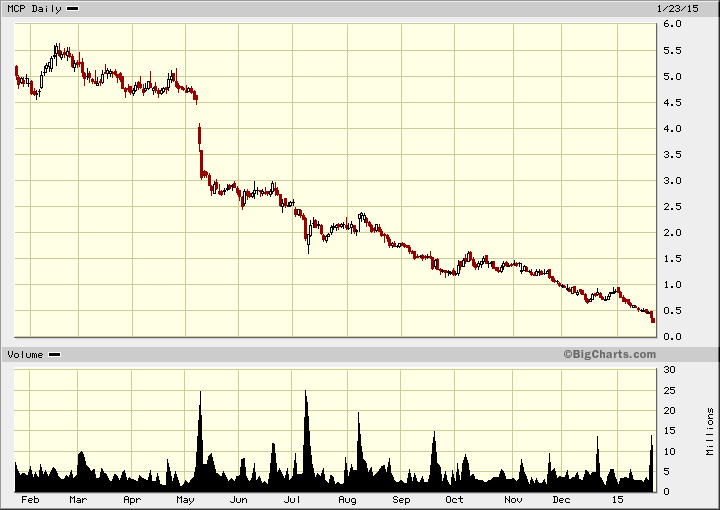
Ehemals mehr als 6 Mrd. USD zu Hype-Zeiten an der Börse wert, heute kurz vor der Pleite. Die Aktie von Molycorp (NYE:MCP) ist seit den Hochständen um mehr als 99% gefallen. Ein Chart, der Bände spricht..
Quelle: bigcharts.com
Labels:
Baisse,
Bust,
Chart,
Hype,
Krise,
Molycorp,
Mountain Pass,
Produzent,
Profitabilitätsprobleme,
Rare Earths,
REE,
Rohstoffe,
Rückblick,
Sell-Off,
Seltene Erden,
Trauma,
USA,
Verluste,
Verschuldung,
Zerstörung
Mittwoch, 12. Februar 2014
Goldman Sachs über die schwerwiegenden Folgen der Geld-Flut
Die schwerwiegenden Konsequenzen der exzessiven Liquiditäts-Flut der Notenbanken werden erst so richtig in den nächsten Jahren und Jahrzehnten aufkommen. Der mächtige Player Goldman Sachs (NYE:GS) ist natürlich über die Auswirkungen auf das eigene Geschäft am meisten besorgt:
„Die Ausweitung der Geldmenge dämpft die Märkte“
07.02.2014, 08:00 Uhr
Die lockere Geldpolitik und neue Bankenregeln bergen große Gefahren für Anleger. Davon ist Goldman-Sachs-President Gary Cohn überzeugt. Im Interview mit der Digitalzeitung Handelsblatt Live erläutert er seine Sorgen.
Gary Cohn, der President der US-Investmentbank Goldman Sachs, fürchtet, dass die Regulierungsoffensive nach der Finanzkrise zu gefährlichen Nebenwirkungen führen wird. „Die Regeln werden die Art, wie wir unser Geschäft betreiben und wie Banken Kapital einsetzen fundamental verändern. Die Liquidität nimmt ab, und das wird unsere Kunden treffen, die Endnutzer und die Verbraucher“, sagte er im Interview mit der Digitalzeitung Handelsblatt Live (Freitagsausgabe). Cohn warnt, dass sich das wahre Ausmaß der negativen Folgen der Regulierung erst zeigen wird, wenn die Notenbanken ihre ultralockere Geldpolitik zurückfahren..
Link: http://www.handelsblatt.com/finanzen/aktien/aktien-im-fokus/goldman-sachs-die-ausweitung-der-geldmenge-daempft-die-maerkte/9446556.html?utm_source=twitterfeed&utm_medium=twitter
Quelle: bigcharts.com
Labels:
Ausblick,
Auswirkungen,
Banken,
Big Picture,
Brisanz,
Bust,
Debt,
Einfluss,
Fiat,
Geldflut,
Geldpolitik,
Goldman Sachs,
Investmentbanken,
Kapital,
Konsequenzen,
Liquidität,
Macht,
Mania,
Notenbanken,
Verschuldung
Abonnieren
Posts (Atom)