Quelle: Market Realist, Company Reports
Unabhängiger Blog über interessante Rohstoff-Stories, spannende Wirtschafts-, Politik- und Finanzthemen, das BIG PICTURE, den Kapitalmarkt, aussichtsreiche Investments, aktuelle und brisante Themen + Trends aus der Rohstoff-, Minen- und Energiebranche, sowie über sämtliche Faktoren, die auf den spannenden Rohstoff-Markt Einfluss nehmen. "The more I learn, the more I realize how much I don‘t know." (A.E.) | Always Do Your Own Due Diligence.
Posts mit dem Label Kostenseite werden angezeigt. Alle Posts anzeigen
Freitag, 3. Juli 2015
Goldproduzenten, Goldminen: All-in Sustaining Kosten pro produzierte Goldunze in 2014
Ein informativer Blick auf die Zahlen im vergangenen Jahr. Die AiSC stellen, was die meisten wissen sollten, lange nicht alle Kosten der Goldproduzenten dar:
Labels:
Agnico Eagle Mines,
AiSC,
All-in Sustaining Kosten,
Barrick Gold,
Eldorado Gold,
Gold,
Goldcorp,
Goldminen,
Goldproduzenten,
IAMGOLD,
Kinross Gold,
Kostenseite,
Newmont Mining,
Ranking,
Übersicht,
Yamana Gold
Donnerstag, 28. Mai 2015
Gold-Minenbranche Südafrika: Groteske Entwicklung und düsterer Ausblick
Beispielloser Absturz des einst weltgrößten Goldproduzenten. Hierzu ein aktueller Bericht von Mineweb:
Could SA’s gold mining industry be gone by 2020?
Peter Major on how management has lost control of their mines.
Patrick Cairns | 27 May 2015 15:40
The South African mining industry is in trouble. That is not in question. The only debatable point is exactly how much trouble it is in..
Quelle: mineweb.com
Quelle: taunggold.com
Labels:
Absturz,
Ausblick,
Belastungsfaktoren,
Gold,
Goldminen,
Goldminenbranche,
Goldpreis,
Goldproduktion,
Goldproduzenten,
Herausforderungen,
Kostenseite,
Minenaktien,
Minenbranche,
Rückgang,
Schwierigkeiten,
Situation
Freitag, 22. Mai 2015
Goldproduzenten: Reale Gesamtkosten der Goldproduktion weiter höher als 1.200 USD/Unze im globalen Durchschnitt
Die totalen Kosten der Goldproduktion (reale All-in Costs) verharren auf einem hohen Niveau. Informatives Update inkl. Analyse von GFMS zu den durchschnittlichen Zahlen im 1. Quartal 2015:
Quelle: GFMS, mineweb, reuters
Labels:
Abschreibung,
all-in Kosten,
Big Picture,
G&A,
Gesamtkosten,
Gold,
Goldaktien,
Goldminen,
Goldminenbranche,
Goldpreis,
Goldproduzenten,
Kosten,
Kostenseite,
Mining,
Royalties,
Verarbeitung
Mittwoch, 22. April 2015
Rohstoff-Gigant BHP Billiton legt solide Produktionsergebnisse in einem anspruchsvollen Markt vor
Starke Zahlen vom weltgrößten Rohstoffproduzenten BHP Billiton (NYE:BHP). Die Produktionskosten in den gigantischen Eisenerzoperationen in Australien betragen nun weniger als 20 USD/Tonne und endlich gibt es auch eine Verzögerung im Hinblick auf die geplanten Kapazitäts-Expansion von Port Hedland, was den Eisenerzpreis umgehend befeuert..
Carl Surran, SA News Editor
- BHP Billiton (NYSE:BHP) says it produced 59M metric tons of iron ore during the three months ending in March, up 20% Y/Y and 5% Q/Q, and raises its output forecast for the year through June by 2% to 230M tons.
- In the first three quarters of its fiscal year, which ends June 30, BHP's output totaled 172.4M tons, up 17% Y/Y.
- BHP says its Western Australian operations have produced a record 188M tons YTD (including the share of minority joint venture partners), and increases full-year guidance for those operations by 2% to 250M tons.
- BHP also says it will defer a project designed to improve capacity for its inner harbor infrastructure at Port Hedland, which will slow its expansion to a targeted 290M ton capacity but at a lower cost.
- BHP does not reveal the exact savings to be achieved by deferring the spending, but RBC Capital analysts estimate the amount at close to $US600M.
Quelle: bhpbilliton.com
Quelle: bigcharts.com
Labels:
Australien,
Auswirkungen,
BHP Billiton,
Big Player,
Branchengiganten,
China,
Eisenerz,
Eisenerzpreis,
Expansion,
Kohle,
Kostenseite,
Kupfer,
Minenaktien,
Port Hedland,
Produktionsergebnisse,
Rohstoffe
Montag, 13. April 2015
NioCorp Development legt mäßige PEA für Elk Creek Niobium Projekt in Nebraska vor
Der Highflyer NioCorp Development (TSX:NB) publizert die heiß erwartete PEA für das Elk Creek Niobium Projekt in Nebraska, welche gemischte Ergebnisse liefert..
NioCorp Announces Positive Preliminary Economic Assessment Results for the Elk Creek Niobium Project
VANCOUVER, BRITISH COLUMBIA--(Marketwired - April 13, 2015) - NioCorp Developments Ltd. ("NioCorp" or the "Company") (TSX:NB)(OTCQX:NIOBF)(FRANKFURT:BR3) On behalf of our shareholders, NioCorp is pleased to announce the completion of a positive Preliminary Economic Assessment (PEA) study for the Elk Creek Niobium project.
Highlights of the PEA include:
- Pre-tax NPV of US$821 million with an IRR of 15.7%
- After-tax NPV of US$562 million with an IRR of 13.9%
- Average EBITDA of US$177 million annually
- A direct cash production cost for ferroniobium of US$6.50 per kg of niobium at an annualized production rate of 7,500 tonnes of ferroniobium per year for full production years, net of titanium dioxide and scandium trioxide credits
- Annual production of 23,000 tonnes of titanium dioxide and 12.8 tonnes of scandium trioxide
- An upfront capital cost of US$653 million, which includes US$136 million for the development of an underground mine and US$517 million for mineral processing, metallurgical and infrastructure costs
- Total upfront capital costs of US$919 million, which includes contingency and owner's costs
The basis for the PEA is a 3,700 tonne per day production rate over a 36 year operating life with an average grade of 0.82% Nb2O5. The NI 43-101 compliant resource supporting this production rate was disclosed in the Company's press release of February 20, 2015. The PEA study was completed by SRK Consulting of Lakewood, Colorado and Roche Ltd. of Quebec City, Quebec.
In addition to the underground mine, the Elk Creek PEA includes a surface crushing, grinding and mineral processing operation to produce a niobium concentrate. The niobium concentrate would be fed to a hydrometallurgical operation that would produce a niobium precipitate as well as titanium dioxide and scandium trioxide co-products. A final pyrometallurgical step would convert the niobium precipitate to ferroniobium using an aluminothermic reduction process. In order to support these processing steps, a number of ancillary facilities would be constructed, including stockpile areas, water pumping and treatment facilities, reagent and fuel storage areas, warehousing, utility installations, office space and a tailings impoundment. The underground mine would be accessed by a shaft and mined using longhole stoping methods with paste backfill utilizing tailings from the mineral processing operation.
"The PEA results are an important milestone in the development of the Elk Creek resource, and I am very pleased to be able to announce results that demonstrate an extremely strong cash flow and very low ferroniobium production costs," said Mark Smith, Executive Chairman of NioCorp. "We will use these results as the basis for a bankable feasibility study for the project, and will continue to pursue the most aggressive schedule possible to bring this world-class resource into production. As with many projects of this size and scope, the return is sensitive to the discount rate. The after tax return ranges from US$940 million to US $420 million with a discount rate between 6 - 9%. We have successfully removed many of the risks associated with the project and look forward to further de-risking as we move the project forward. I am looking forward to the completion of the formal PEA report in the near future..."
Quelle: bigcharts.com
Labels:
Elk Creek,
Highflyer,
Junioraktien,
Kostenseite,
Mark Smith,
Minenaktien,
Nebraska,
Niob,
Niobium,
NioCorp Development,
PEA,
Profitabilität,
Projektentwicklung,
Seltene Erden,
USA,
Wirtschaftlichkeitsstudie
Dienstag, 24. März 2015
Folgen des Öl- und Kupferpreis-Absturzes: Freeport-McMoRan nimmt drastische Dividenden-Kürzung vor
Die Dividenden-Kürzung um 84% war im Aktienkurses des Minengiganten Freeport-McMoRan (NYE:FCX) bereits weitgehend eingepreist..
Freeport axes dividend by 84% amid weak commodity prices
Cecilia Jamasmie | March 24, 2015
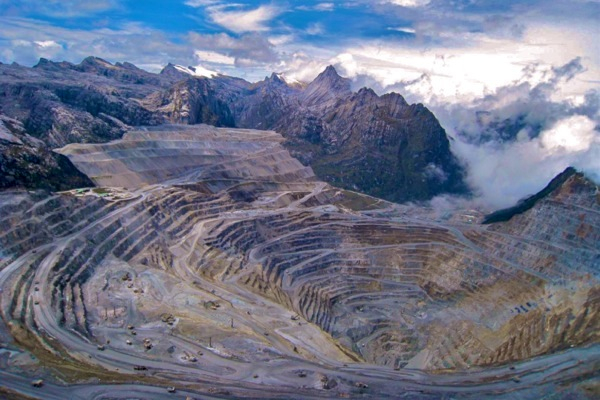
Freeport’s Grasberg copper mine in Indonesia.
Shares in Freeport-McMoRan (NYSE:FCX), the U.S. largest miner by market value and revenue, were down Tuesday morning after the U.S. copper miner announced it had slashed its quarterly dividend by 84%, citing lower commodity prices..
Quelle: bigcharts.com
Labels:
Absturz,
Aufwendungen,
Baisse,
Bärenmarkt,
Belastungsfaktoren,
Dividende,
Folgen,
Freeport,
Herausforderungen,
Konsequenzen,
Kostenseite,
Kupferpreis,
Kupferproduzent,
Kürzung,
Minenbranche,
Minengigant,
Ölpreis
Sonntag, 15. März 2015
Nächste Insolvenz in der Goldminenbranche: Produzent Allied Nevada
Der brutale Absturz eines einstigen Highflyers der Goldminenbranche endet in der Insolvenz:
Quelle: bigcharts.com
Allied Nevada Gold Files For Bankruptcy Protection
Submitted by Tyler Durden on 03/10/2015 13:54 -0400
Just as in the case of oil currently, the problem with gold (and countless other commodities) trading where it does, is that as we have shown repeatedly on previous occasions, it is at or below the marginal production cost of various gold producers.
And with miners losing money on every incremental ounce (or barrell) they pull out of the ground, there is only so much capital they can burn before they have not choice but to file for bankruptcy. Which is precisely what happened to Allied Nevada Gold, the operator of the gaming state’s Hycroft mine, which earlier today filed for bankruptcy in Delaware.
The company blamed its deteriorating financial condition on the drop in gold and silver prices in recent years, an overleveraged capital structure, delays in a key expansion project, and currency swap exposure.
Yes, this is that Allied Nevada whose stock price traded as high as $45 when gold hit its all time high of over $1,900 hours before the SNB imposed its first, and now failed, currency floor which translated into a market cap of just about $4.5 billion..
Labels:
Absturz,
Allied Nevada Gold,
Brisanz,
Chart,
Druck,
Gold,
Goldaktien,
Goldminen,
Goldminenbranche,
Goldproduzent,
Insolvenz,
Kostenexplosion,
Kostenseite,
Nevada,
Profitabilitätsprobleme,
Schulden,
Verluste
Dienstag, 24. Februar 2015
Rohstoff-Gigant BHP Billiton legt Halbjahreszahlen vor und übertrifft Erwartungen
Der Branchenführer im globalen Minensektor, BHP Billiton (ASX:BHP), verkündet die Finanzergebnisse für das letzte Firmen-Halbjahr und kann erfolgreich die Gewinnerwartungen schlagen. Zudem kommen die Aktionäre in den Genuss einer 5%igen Didivenden-Erhöhung..
BHP's H1 profit
cut nearly in half, costs nearly 25% lower
Carl
Surran, SA News Editor
- BHP Billiton (NYSE:BHP) reports a 47%
Y/Y drop in net profit to US$4.27B for the six months through
December, down from a $8.11B profit a year earlier but ahead
of analyst consensus for $3.59B.
- BHP's underlying profit for the six months, which
excludes non-cash charges against assets including some oil fields in
North Louisiana, was down 31% Y/Y at $5.35B; however, BHP is raising its
interim dividend 5% to US$0.62/share.
- BHP says it spent $6.4B on finding and developing new
deposits and in expanding existing ones, but that was 23% lower than the
$8.3B it spent in the same six-month period a year earlier.
- Also says it is focusing its cap spending more on improving efficiency and reducing costs at its existing projects rather than developing new ones.
Quelle: bhpbilliton.com
Quelle: bigcharts.com
Labels:
Aktionäre,
BHP Billiton,
Branchenführer,
Branchengiganten,
Dividenden,
Eisenerz,
Erwartungen,
Gewinne,
Kohle,
Kostenseite,
Kupfer,
Major,
Margen,
Öl,
Petroleum,
Pottasche,
Profitabilität,
Rohstoffe,
Stärke,
Uran
Montag, 23. Februar 2015
Gold-Major AngloGold Ashanti publiziert ordentliche Finanzergebnisse für 2014
Der drittgrößte Goldproduzent der Welt, AngloGold Ashanti (NYE:AU), verkündet die Finanzergebnisse für das 4. Quartal und Gesamtjahr 2014. AngloGold gelingt es die Kosten weiter zu senken und kann den operativen Cashflow trotz niedrigerer Goldpreise ordentlich ankurbeln..
AngloGold Output Rises for 2nd Straight Year; Costs Fall 13%
JOHANNESBURG, SOUTH AFRICA--(Marketwired - February 23, 2015) - AngloGold Ashanti (NYSE : AU) today posted its second consecutive growth in annual production alongside a 13% improvement in all-in sustaining costs, as it continued to focus on portfolio improvements and capital discipline.
Production rose 8% to 4.44Moz at an all-in sustaining cost of $1,026/oz in the 12 months through December 31, 2014, from 4.10Moz at $1,174/oz the previous year. The result compared with guidance of 4.2Moz to 4.5Moz at an all-in-sustaining cost of $1,025/oz to $1,075/oz. All-in sustaining cost is a measure that captures direct operating costs, corporate and exploration expenditure and capital investment required to sustain the business.
"The second year of growth is gratifying but the real focus for us is on improving margins," Chief Executive Officer Srinivasan Venkatakrishnan said. "Regardless of the gold price, we won't relax the pressure on costs or hesitate to take out marginal production if needed."
AngloGold Ashanti has over the past 24 months taken decisive action to cut overhead expenditure by two-thirds while improving the quality of its portfolio by bringing into production two new, low-cost mines, selling some assets, closing others and removing loss-making ounces from ongoing operations. All-in sustaining costs for 2014 are 18% lower than they were in 2012, while production is up 12% over the same period as Kibali and Tropicana have ramped up output..
Quelle: anglogoldashanti.com
Quelle: bigcharts.com
Labels:
AngloGold,
Cashflow,
Gold,
Goldaktien,
Goldminen,
Goldpreis,
Goldproduktion,
Goldproduzenten,
Herausforderungen,
Kostenseite,
Kostensparprogramme,
Optimierung,
Schulden,
Südafrika,
Verbesserung,
Wachstum
Freitag, 20. Februar 2015
Newmont Mining schlägt Prognosen und bekommt die Kostenseite zunehmend besser in den Griff
Der zweitgrößte Goldproduzent der Welt, die amerikanische Newmont Mining (NYE:NEM), legt diese Woche starke Zahlen vor und kann die Gesamtkosten in 2014 um 10% senken. Dadurch erhöhen sich die Profit-Margen und die Bilanzlage kann bedeutend verbessern werden..
Newmont Mining
sees 2015 production, costs flat Y/Y
Carl
Surran, SA News Editor
- Newmont Mining (NYSE:NEM) +1.4% AH following better than expected Q4
earnings and revenues.
- Q4 attributable gold production totaled 1.26M oz.,
below the 1.45M oz. in the prior-year quarter, due mainly to the impact of
divestments; full-year output was 4.85M oz., less than 5.07M oz. produced
in 2013.
- Q4 all-in sustaining costs were $927/oz., the second
consecutive sub-$1K quarter; full-year all-in sustaining costs were
$1,002, a 10% improvement vs. 2013.
- NEM expects 2015 attributable gold production of
4.6M-4.9M oz., with all-in sustaining costs of $960-$1,020/oz.
Newmont
Mining beats by $0.07, beats on revenue
Mohit
Manghnani, SA News Editor
- Newmont Mining (NYSE:NEM): Q4 EPS
of $0.17 beats by $0.07.
- Revenue of $2.02B (-7.8% Y/Y) beats
by $210M.
- Press Release
Quelle: newmont.com
Quelle: newmont.com
Quelle: newmont.com
Quelle: newmont.com
Quelle: bigcharts.com
Labels:
Analysen,
Ausblick,
Bilanzlage,
Branchengiganten,
Finanzen,
Finanzergebnisse,
Gesamtkosten,
Gewinne,
Gold,
Goldpreis,
Goldproduzenten,
Kostenseite,
Major,
Margen,
Newmont,
Newmont Mining,
Profitabilität,
Prognosen
Dienstag, 9. Dezember 2014
J.P. Morgan stuft Ausblick für Eisenerz-Sektor erneut ab, Talfahrt bei den Minenaktien hält an
Die jüngsten Abstufungen sorgen dafür, dass die Branchen-Schwergewichte wie BHP Billiton (NYE:BHP), Rio Tinto (NYE:RIO) und Vale (NYE:VALE) auf neue Jahrestiefstände einbrechen..
Iron ore outlook cut by J.P. Morgan as BHP, Rio shares extend slump
Carl
Surran, SA News Editor
- Mining companies sink in premarket trading as J.P. Morgan lowers its iron ore outlook through 2017, predicting prices will extend declines as growth in low-cost supply from the world’s largest producers outstrips demand.
- Iron ore will average $67/metric ton next year, 24% less than previously forecast, $65 in 2016, down 23%, and $69/ton in 2017, down 16%, the firm says; iron ore has averaged $98.82/ton YTD but recently slumped to a five-year low $68.49.
- "The only way the oversupply can be averted is if the low-cost producers cut back on their growth targets," which is unlikely, JPM says, as "feedback from recent site visits to the Pilbara suggests there is currently no consideration for slowing capacity growth from either Rio Tinto or BHP Billiton."
Quelle: bigcharts.com
Labels:
Abstufung,
Ausblick,
Belastungsfaktoren,
BHP Billiton,
Eisenerz,
Eisenerzbranche,
JP Morgan,
Kostenseite,
Majors,
Produktion,
Rio Tinto,
Rohstoffaktien,
Rohstoffe,
Sell-Off,
Talfahrt,
TXGM,
Überangebot,
Vale,
Wachstum
Montag, 22. September 2014
Goldproduzenten: Gesamtkosten der Goldproduktion sind drastisch in den letzten 10 Jahren angestiegen - fallen aber seit einigen Quartalen zurück
Review zur Kosteinflation mit einem aktuellen Artikel von The Globe and Mail:
How much does it really cost to mine an ounce of gold?
David Milstead - Special to The Globe and Mail - Published Friday, Sep. 19 2014, 6:45 PM EDT
For years, miners liked to talk about “cash costs,” the mine-level expenses of pulling an ounce of gold from the ground. For the most part, cash costs ran from $500 (U.S.) to $800 per ounce, depending on a miner’s properties..
Link: http://www.theglobeandmail.com/globe-investor/investment-ideas/how-much-does-it-really-cost-to-mine-an-ounce-of-gold/article20709844
Quote:
Senior-Goldproduzenten: Kosten fallen mehrere Quartale nacheinander - das erste Mal seit 1998
Nach mehr als 15 Jahren Kosteninflation schaffen die Majors bedeutende Senkungen. Doch der Schein trügt..
Link: http://rohstoffaktien.blogspot.de/2014/06/senior-goldproduzenten-kosten-fallen.html
How much does it really cost to mine an ounce of gold?
David Milstead - Special to The Globe and Mail - Published Friday, Sep. 19 2014, 6:45 PM EDT
For years, miners liked to talk about “cash costs,” the mine-level expenses of pulling an ounce of gold from the ground. For the most part, cash costs ran from $500 (U.S.) to $800 per ounce, depending on a miner’s properties..
Link: http://www.theglobeandmail.com/globe-investor/investment-ideas/how-much-does-it-really-cost-to-mine-an-ounce-of-gold/article20709844
Quelle: theglobeandmail.com, anglogold.com
Quote:
Senior-Goldproduzenten: Kosten fallen mehrere Quartale nacheinander - das erste Mal seit 1998
Nach mehr als 15 Jahren Kosteninflation schaffen die Majors bedeutende Senkungen. Doch der Schein trügt..
Link: http://rohstoffaktien.blogspot.de/2014/06/senior-goldproduzenten-kosten-fallen.html
Labels:
all-in Kosten,
Ausblick,
Auswirkung,
Big Picture,
Fundamentals,
Gold,
Goldminen,
Goldminenbranche,
Goldproduzenten,
Juniorbranche,
Kosten,
Kostenfaktor,
Kosteninflation,
Kostenseite,
Majors,
Mining,
Trend,
Wandel
Dienstag, 24. Juni 2014
Senior-Goldproduzenten: Kosten fallen mehrere Quartale nacheinander - das erste Mal seit 1998
Nach mehr als 15 Jahren
Kosteninflation schaffen die Majors bedeutende Senkungen.
Quelle: Wood Mackenzie, OwnDD/Analysis
Die großen Goldproduzenten schaffen es zum ersten Mal seit
1998 die Förder- und Gesamt-Kosten der Gold-Produktion mehrere Quartale (~) hintereinander
deutlicher zu senken. Dieser Trend unterstreicht zunächst funktionierende Kostenspar- und Optimierungs-Programme, sowie den erfolgreichen Wandel (zumindest Trend) in den
Unternehmens-Philosophien hinzu einem robusteren Goldminen-Business.
Im 1. Quartal 2014 geht es mit den All-in Sustaining Kosten
(d.h. die Gesamtkosten der laufenden Minen) der führenden, westlichen Goldproduzenten (Majors) um weitere 8% nach unten. Der
Durchschnitt der All-in Sustaining Kosten der Senior-Goldproduzenten summiert sich so im 1.
Quartal auf 939 USD/Oz (Bloomberg-Daten) und liegt damit auf einem wesentlich besseren Level als der Durchschnitt der letzten 4 Quartale (> 1.050 USD/Oz).
Hierbei darf man aber nicht vergessen, dass einige
Sonderfaktoren die Kostensenkungen verzerren, z.B. Erhebliche Rationalisierung
in den Verwaltungen, starkes 'high grading' und immense Reduzierungen der
Explorations-CAPEX.
Es ist für mich klar, dass die totalen Produktions- und
Gesamtkosten des Gold-Bergbaus nur marginal im Großen Bild rückläufig sein
werden und auch in Zukunft auf einem hohen Level liegen.
Der Grund hierfür ist relativ einfach: Die besten,
hochgradigsten und profitabelsten Goldprojekte sind in der Masse einfach ausgebeutet
– und die werden kaum wiederkommen. Bei den preissensibleren (Groß-)Goldvorkommen (large bulk tonnage) liegt daher klar der Gros des zukünftigen Goldminen-Angebots (20-100+ Jahre).
Und diese Lagerstätten-Art ist und wird logischerweise keinesfalls
günstig auszubeuten sein. Hier rede ich jetzt wirklich von den nächsten Minenzyklen und meine nicht das primäre Goldminen-Angebot für die nächsten Jahre.
Zudem sehen wir zahlreiche Kostenfaktoren wie bspw. Wasser,
Energie, Diesel, die eher unwahrscheinlich in der Zukunft wieder stärker
rückläufig sein werden; wenn dann nur wohl temporär.
Daher ist es nur logisch, dass das globale Gesamt-Kostenlevel im Goldminen-Sektor in den nächsten Jahren und Jahrzehnten auf einem hohen Niveau bleiben wird und weiter ansteigt. Dies unterstreicht auf der anderen Seite im Hinblick auf die Angebotsseite auch gut die (nachhaltig logische) 'fundamentale Absicherung' des Goldpreises bei den realen All-in Kosten.
Jedoch ist es auch absolut ersichtlich, dass die großen
Goldminen-Konzerne nach der Mega-Baisse in 2012 und 2013 wieder besser ihre
Kostenseite in den Griff bekommen – und das ist sehr wichtig. Dies ist vor
allem vor dem Hintergrund relevant, da keine Unterstützung vom Goldpreis kam.
So zeigen die Goldproduzenten, dass sie auch in diesem schwierigen
Goldpreis-Umfeld auf der Kosten- und Profitabilitäts-Basis voranschreiten
können.
Mit dem "neuen" Fokus auf Profitabilität,
Kapitaleffizienz und realer, nachhaltiger Rendite scheinen die Goldproduzenten
wieder auf einen besseren, operativen Kurs zukommen. Dies bestätigen die
(vergleichsweise) ordentlichen Finanzergebnisse des 1. Quartals mit
zahlreichen, geschlagenen Prognosen. Weiter haben sich die Transparenz und das
Reporting der realen Kostenlage massiv in den letzten 18 Monaten verbessert.
Das ist genau die richtige Entwicklung für die Bildung von neuem Vertrauen.
Alle oben genannten Konstellationen spielen vor allem der
raren Art von Junior-Firmen in der Gold-Branche rein, welche wirklich noch auf
einem erstklassigen, high-grade und/oder high-margin Projekt sitzt, das
nebenbei vllt. noch Explorations-Potential und eine ordentliche Lokalisierung besitzt.
Wenn dann noch die Minen-CAPEX halbwegs passt, d.h. real und konstruktiv
finanzierbar ist, dann sollten genau diese wenigen Firmen in Zukunft nur
wertvoller werden.
Quelle: Wood Mackenzie, OwnDD/Analysis
Labels:
all-in Kosten,
Ausblick,
Auswirkung,
Big Picture,
Fundamentals,
Gold,
Goldminen,
Goldminenbranche,
Goldproduzenten,
Juniorbranche,
Kosten,
Kostenfaktor,
Kosteninflation,
Kostenseite,
Majors,
Mining,
Trend,
Wandel
Abonnieren
Posts (Atom)