
Posts mit dem Label BoE werden angezeigt. Alle Posts anzeigen
Posts mit dem Label BoE werden angezeigt. Alle Posts anzeigen
Sonntag, 25. Juni 2017
Big Picture: Bilanzsumme der führenden Zentralbanken knackt die Marke von 15 Billionen US-Dollar
Alleine seit Jahresanfang haben die Zentralbanken der westlichen Welt ihre Bilanzen um irrwitzige 1,5 Billionen US-Dollar erweitert..


Samstag, 22. April 2017
Big Picture: Aufkaufprogramme der Zentralbanken erreicht neues Rekordhoch
Noch nie zuvor haben die führenden Zentralbanken höhere Summen an Finanzanlagen aufgekauft wie in 2017 YTD:


Quelle: zerohedge.com, BofA

Quelle: zerohedge.com, Deutsche Bank
Freitag, 21. April 2017
Gold: Zentralbanken bleiben auf der Käuferseite aktiv
In den letzten Jahren haben die führenden Notenbanken immense Summen an physischem Gold erworben:


Quelle: usfunds.com
Montag, 10. Oktober 2016
Großbritannien: Inflationserwartungen ziehen signifikant an
Parallel zum anhaltenden Pfund-Crash steigen die Inflationserwartungen auf der Insel erheblich an:


Quelle: bloomberg.com
Donnerstag, 8. September 2016
Big Picture: Bilanzsummen der wichtigsten Notenbanken steigen auf neues Rekordhoch
Die gigantische Aufblähung der Bilanzsummen der Notenbanken geht in die nächste Runde. Die aggregierte Summe der Bilanzen nähert sich bereits der Marke von unfassbaren 20 Billionen US-Dollar bzw. 40% des GDPs der involvierten Nationen..

Quelle: Citi Research, Haver
Montag, 8. August 2016
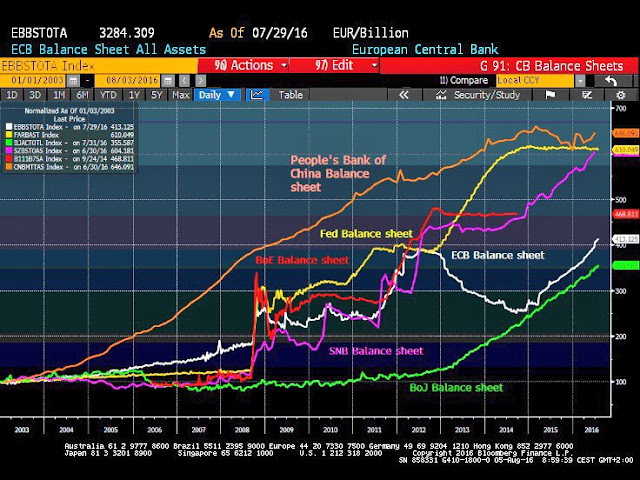
Liquiditätsflut der Notenbanken hält an: Bilanz-Entwicklung der FED, EZB, BoJ, BoE, SNB und PBoC seit 2003
Die Liquiditätsschwemme der weltweiten Zentralbanken während der letzten 13 Jahre bleibt historisch. So geht größte Finanzexperiment der Menschheitsgeschichte in die nächste Runde..

Quelle: bloomberg.com
Mittwoch, 27. Juli 2016
Big Picture: Gold vs. Realzinsen
Im Zuge der globalen Null- und Negativ-Zinsen, welche die entscheidenden Realzinsen weiter unter Druck bringen, wird das gelbe Metall immer attraktiver.


Quelle: stockcharts.com, theydailygold.com

Quelle: goldseiten.de
Big Picture: QE-Wahn läuft weiter, expansive Geldpolitik auf Allzeithoch
Zwar hat die FED die QE-Maßnahmen eingestellt, doch die expansive Geldpolitik in der westlichen Welt bewegt sich auf einem Rekordhoch. Dies ist natürlich auf die extrem expansive Geldmarktpolitik in der EU und in Japan zurückzuführen..


Quelle: zerohedge.com
Sonntag, 17. Juli 2016
Rohstoff- und Minenbranche: Der Wochenrückblick von Haywood
Werfen Sie einen Blick in den informativen Wochen-Rückblick:
The Weekly Dig
Haywood Mining Team
Gold Price Falls as both the Banks of England and Canada Held Rates Steady
§ Equity markets in the U.S. and Canada rose further this week, despite continued sluggish economic growth. Both the Dow Jones Industrial Average and S&P 500 Index extended all-time highs on Thursday, prompting several money managers in the U.S. to issue caution that the rally could be short-lived, with suggestions that the global economy would continue to remain sluggish while concerns over the ramifications of the Brexit vote continued. While equity markets rallied, the price of gold fell during the week, falling as low as $1,320 on Thursday during intra-day trading. On Friday, a truck filled with weapons ploughed into a large crowd of spectators celebrating Bastille Day in Nice, France, only eight months after the Paris attacks in November. The latest death toll at the time of publication was 84; however, despite the tragedy, markets remained relatively steady, with the S&P/TSX Composite index finishing 3.8% higher for the week. Following the attack, gold fell further before finishing at $1,329 per ounce on Friday. The lower gold price coincided with the Bank of England’s surprising decision to keep its key interest rate at 0.5%, while the Bank of Canada also kept its interest rate on hold. Meanwhile, silver (↓0.9%) and platinum (↓0.8%) were also down, finishing at $20.10 and $1,089 per ounce respectively. Base metals rallied during the week, with copper leading the way, gaining 4.1% to finish at $2.22 per pound, while nickel (↑3.9%), lead (↑3.04%) and zinc (↑2.82%) each finished at $4.64, $0.85 and $1.00 per pound respectively. WTI prices rose after last week’s heavy losses, up 1.2% for the week. Finally, the UxC Weekly Spot Price of uranium fell 5% during the week, as the Broker average price closed at $25.13 per pound on Friday.
This report may be distributed in the following states: nil. Otherwise, this report may only be distributed into those states with an institutional buyer state securities registration exemption.
Montag, 23. Mai 2016
Positiv für Gold: Realzinssatz verweilt im negativen Bereich
Informativer Chart, der die negative Korrelation zwischen den realen Zinsen und dem Goldpreis auf einen Blick aufzeigt. Aufgrund der zunehmenden "Null- und Negativzinsen" in der Westlichen Welt, bleibt der reale Zinssatz im negativen Bereich..

Quelle: BlackRock
Samstag, 14. Mai 2016
Der Aufstieg der Deflation
Vor allem in der Westlichen Welt ist der deflationäre Trend seit einigen Jahren auf dem Vormarsch..

Quelle: reuters.com
Donnerstag, 12. Mai 2016
Entwicklungen der globalen Devisen-Reserven
Die globalen Devisen-Reserven fallen seit 2014 zurück. Sehr interessant sind vor allem die Entwicklungen in den Emerging Markets inkl. China. Der Blick auf den informativen Langfrist-Chart:


Quelle: J.P. Morgan, IMF
Mittwoch, 25. November 2015

Donnerstag, 12. November 2015

Samstag, 15. August 2015
Gold vs. Global Monetary Base: Geld- und Schulden-Flut der Zentralbanken gibt den Weg vor
Informativer Chart - credit to Carpathia Capital:


Mittwoch, 10. Juni 2015
Gold: Entwicklung der Zentralbank-Käufe
Informativer Chart von Tocqueville:


Quelle: Tocqueville Q1 2015 Report, WGC
Mittwoch, 20. Mai 2015
Big Picture: Geldumlaufgeschwindigkeit weiter rückläufig
Brisante Entwicklung:

Hierzu ein aktueller Bericht von Martin Armstrong - featured by Zerohedge:
 Submitted by Tyler Durden on 05/17/2015 14:10 -0400

Quelle: zerohedge.com
Hierzu ein aktueller Bericht von Martin Armstrong - featured by Zerohedge:
Martin Armstrong Warns Of The Coming Crash Of All Crashes
- Capital Formation
- Central Banks
- Federal Reserve
- Glass Steagall
- Martin Armstrong
- Nationalization
- recovery
- Unemployment
Why are governments rushing to eliminate cash?
During previous recoveries following the recessionary declines, the central banks were able to build up their credibility and ammunition so to speak by raising interest rates during the recovery. This time, ever since we began moving toward Transactional Banking with the repeal of Glass Steagall in 1999, banks have looked at profits rather than their role within the economic landscape.
They shifted to structuring products and no longer was there any relationship with the client. This reduced capital formation for it has been followed by rising unemployment among the youth and/or their inability to find jobs within their fields of study. The VELOCITY of money peaked with our Economic Confidence Model 1998.55 turning point from which we warned of the pending crash in Russia...
Donnerstag, 30. April 2015
Wichtigste Zentralbanken der Welt : Aggregierte Bilanzsumme steigt um 11 Billionen USD seit 2007 an
And more to come..

Quelle: db.com
Abonnieren
Posts (Atom)