Posts mit dem Label Chinesen werden angezeigt. Alle Posts anzeigen

Dienstag, 26. Januar 2016

Demographische Trends in China: Die große Verschiebung in die Westliche Welt

Spannender Artikel von Mineweb über ein sehr relevantes Thema, das ebenfalls großen Einfluss auf den Rohstoffmarkt hat:

China’s demographic trends – the big shift west

Are they commodity supportive?

Warren Dick | 25 January 2016 00:37

Where do resource markets go from here? That’s the trillion-dollar question investors are attempting to answer as they quietly reconcile themselves to the fact that the billions spent investing in supply over the last decade may now be completely unwanted..

Sonntag, 5. Juli 2015

Nach starkem China-Deal voll auf Kurs: Interview mit dem Managing Director von Kupfer-Developer Altona Mining

Developer Altona Mining (ASX:AOH) hat es erneut geschafft. Die erfolgreiche Junior-Firma erzielte zuletzt einen beeindruckenden Deal mit einem bedeutenden, chinesischen Konsortium.

Altona's großes Kupfer-/Gold-Projekt Cloncurry (> 1.400km²), welches sich in Queensland befindet, wird nun zusammen mit der kapitalstarken und einflussreichen Sichuan Railway Investment Group ("SRIG") in einem Joint-Venture Richtung kommerzielle Kupfer-Produktion entwickelt.

Altona erhält somit einen erstklassigen Projekt-Partner für das Flaggschiff Clongurry, der das aussichtsreiche Asset kräftig vorantreiben kann - und wird. Mitten in einem der schwersten Bärenmärkte für Rohstoff- und vor allem Junior-Minenaktien aller Zeiten, ist das ein beachtlicher Deal, den die Verantwortlichen hier erzielen konnten.

Vor ein paar Tagen hatte ich die Möglichkeit mit Dr. Alistair Cowden (Managing Director bei Altona) im Rahmen einer Europa-Roadshow von der Swiss Resource Capital AG zusammenzukommen.

Folgend ein paar kurze Statements zu meinem Gespräch mit Mr. Cowden, der einer der erfolgreichsten Manager in der australischen Junior-Minenbranche ist:
  • "Game Changer" Deal und bereits der zweite, sehr signifikante Deal (vgl. profitabler Goldminen-Verkauf in Finnland), den Altona in einer der schwierigsten Marktphasen im Minensektor erreichte.
  • Großartiges Kommitment und Vertrauen von SRIG in Altona's Flaggschiff-Asset.
  • Altona's Clongurry ist eine der wenigen Kupfer-Projekt weltweit, die in der aktuellen Marktphase ein starkes Interesse erhalten. Hauptgrund natürlich: Nur wenige, neue Kupfer-Vorkommen, welche sich im Entwicklungs-Stadium befinden, machen beim aktuellen Kupferpreis richtig Sinn und können eine solide Rendite generieren.
  • SRIG commited sich für Investitionen in Höhe von 214 Mio. US-Dollar in die Projekt-Entwicklung von Clongurry. Im Hinblick auf Altona's Börsenwert und die Marktsituation sind das definitiv herausragende Investitionen.
  • "Keine Aufnahme von Schulden notwendig" stellt ein sehr großes Privileg für Altona dar.
  • Das von SRIG bereitgestelltes Kapital wird nach den Prognosen (siehe finale Wirtschatflichkeits-Studie) ausreichen, um Clongurry's "Little Eva" Lagerstätte in die kommerzielle Produktion zu bringen.
  • JV-Terms: SRIG erhält ein 60%iges Interesse, Altona wird 40% kontrollieren. Im Hinblick auf die bedeutende Investitions-Menge und die Marktlage sind das absolut starke Konditionen, die Altona hier herausholen konnte. Das Management hat hart an diesen Terms gearbeitet.
  • Altona verfügt weiterhin über starke, strategische Aktionäre und Story-Unterstützer.
  • Cowden ist für die mittel- bis längerfristige Entwicklung im Kupfer-Sektor sehr optimistisch und sieht den schwerwiegenden "Schweine-Zyklus" im Kupfermarkt, der die meisten Rohstoff-Sektoren enorm belastet, im letzten Kapitel angelangt.
  • Cowden sieht eine weiche Landung der chinesischen Wirtschaft kommen.
  • Altona's MD sieht den Kupfermarkt im Hinblick auf die Angebotsseite auch in einem wesentlich besseren Umfeld als bspw. die Situation bei Eisenerz, Kohle und Gold. Nach Cowden werden wir mittelfristig ein Angebots-Defizit im Kupfermarkt sehen.
  • Cowden: "Wir benötigen mindestens einen Kupferpreis von 3,25 USD pro Pfund, damit die meisten, noch nicht ausgebeuteten Kupfervorkommen, überhaupt eine Chance haben, signifikant Richtung kommerzieller Produktion voranzuschreiten.Wohl dem, der über besonders wettbewerbsstarke Kupfer-Projekte verfügt, die auch in diesem Preisumfeld funktionieren."
  • Viele der größten Kupferminen weltweit (vgl. Escondida) können sehr schwierig ersetzt werden. Dies wird den Druck auf die Angebotsseite in der Zukunft kontinuierlich erhöhen.
  • Urbanisierung, Infrastruktur-Investitionen, Weltbevölkerungs-Wachstum und technologische Innovationen werden dafür sorgen, dass die Kupfernachfrage weiter stabil zulegen wird.
  • China ist de facto der einzige, mächtige Spieler weltweit, der aktuell im großen Stil antizyklisch im Rohstoff- und Minensektor investiert. Dieser Trend wird sich nach Cowden noch beschleunigen.

Aktuelle Präsentation zum SRIG-Deal: http://www.altonamining.com/static/uploads/documents/AOH0700_-_Presentation_on_SRIG_Transaction_r.pdf

Altona's Managing Director stellte sich letzter Woche einer informativen Q&A-Session:


Quelle: altonamining.com


Quelle: altonamining.com


Quelle: altonamining.com


Quote:

Kupfer-Projektentwickler Altona Mining: Informative Analyse von Ringler Research

Lesenswertes Research zur kapitalstarken Junior-Firma Altona Mining (ASX:AOH), die sich nach dem erfolgreichen Verkauf der Assets in Finnland nun voll auf das fortgeschrittene Kupfer-Projekt Cloncurryin Australien fokussieren können..

Link: http://rohstoffaktien.blogspot.de/2015/05/kupfer-projektentwickler-altona-mining.html

Mittwoch, 10. Juni 2015

Eisenerz: Preis hält sich stabil nahe 4-Monatshoch trotz negativer Import-Daten aus China - Gutes Zeichen für eine Bodenbildung

Hierzu ein aktueller Beitrag von Mining.com:
Iron ore price holds despite 12% fall in Chinese imports

Frik Els | June 8, 2015
Iron ore price holds despite 12% fall in Chinese importsThe price of iron ore held onto near four-month highs on Thursday despite fresh evidence of weakening demand in the 1.3 billion tonne seaborne iron ore market.
The benchmark 62% Fe import price including freight and insurance at the Chinese port of Tianjin was steady at $63.80 a tonne according to data provided by The SteelIndex, the highest since mid-February.
A rally that began April has seen the price rise by more than 36% from record lows struck at the beginning of April but the steelmaking raw material still trades nearly 10% below 2015's opening levels..

Quote:
Quelle: Saxo Bank, Bloomberg, Mining.com

Mittwoch, 27. Mai 2015

Kanadische Uranfirmen: Schon bald auf China's Kaufzettel?

Hierzu ein aktueller Beitrag von der NationalPost:

Canadian uranium companies could be on China’s buy list

China is likely to start scooping up uranium companies to fulfill domestic demand, and Canadian firms could be targets.
Martin Divisek/BloombergChina is likely to start scooping up uranium companies to fulfill domestic demand, and Canadian firms could be targets.
China’s growing nuclear program has the country on the hunt for uranium acquisitions, and Canadian companies could be on the list.
The head of China National Nuclear Corp. (CNNC), Wang Ying, said earlier this month that China is looking for companies with large deposits and low costs to meet domestic demand. The acquisition criteria he outlined includes companies that have at least 30,000 tonnes of uranium resource, cash production no higher than US$25 a pound and total production costs of no more than US$45 a pound.
Rob Chang, analyst and head of metal and mining at Cantor Fitzgerald, said that four projects in Canada could immediately fall under China’s radar based on the criteria.
One would be Fission Uranium Corp.’s Patterson Lake South project, which meets the criteria for size, but whose costs haven’t been finalized yet. Cameco Corp.’s Millennium deposit falls just short on size, but its costs are likely in range. UEX Corp.’s Shea Creek deposit meets the size criteria, though costs haven’t yet been determined. Finally, Rio Tinto Canada Uranium Corp.’s Roughrider project could also attract attention, since it’s the right size and its costs are likely in range.
Those projects make their companies stand out for immediate investment from China, but Chang points out that CNNC has said acquisitions would take place on a five-year timeline, which means additional projects could get China’s attention. These include NexGen Energy Ltd.’s Arrow project, Kivalliq Energy Corp.’s Angilak deposit, Denison Mines Corp.’s Wheeler River Project and Areva’s Midwest project.

Donnerstag, 21. Mai 2015

Chinesischer Gold-Standard würde einen Goldpreis von 64.000 USD/Unze benötigen

Lesenswerter Beitrag von Bloomberg:

Chinese Gold Standard Would Need a Rate 50 Times Bullion’s Price

By Nicholas LarkinEddie Van Der Walt - 1:16 PM CEST  May 20, 2015

A move to a gold standard in China would require an exchange rate of as much as $64,000 an ounce, 50 times bullion’s price now, according to Bloomberg Intelligence.

A traditional gold standard, in which the precious metal backs the currency, is basically impossible at current prices due to the amount of metal needed and there’s no evidence the sixth-biggest bullion holder will adopt one, Bloomberg Intelligence said in reports published Wednesday. Any attempt probably would involve new technologies and depend on the ratio of what is backed, it said.

Chinese policy makers are trying to establish the yuan as a reserve currency, and backing it with gold would help attract foreign capital inflows, the Bloomberg research unit wrote. Theoretically, to create an exchange rate of one ounce of gold for every $64,000, the country would need about 10,000 metric tons of the metal, they estimated. That’s nine times the nation’s official holdings and about 6 percent of all the bullion ever mined globally.

“It would probably have to be very different than an old gold standard,” Kenneth Hoffman, the Princeton-based head of global metals and mining research at Bloomberg Intelligence, said in an interview in London on Tuesday. “They have all this currency out there, they want it all soaked up by central banks...”

Mittwoch, 13. Mai 2015

Kupfer: Chinesicher Hedgefonds vergrößert seinen massiven Short an der Shanghai Futures Exchange

Am Kupfer-Terminmarkt wird wieder enorm gezockt, ganz vorne dabei sind erneut die Chinesen..
Chinese fund doubles down on copper short
By Henry Sanderson
One of the Chinese funds reckoned to be behind a precipitous fall in the price of copper at the start of the year has not followed its peers and closed its bearish bets on the industrial metal.
Chaos Ternary Futures, a unit of Shanghai Chaos, remains the biggest holder of short contracts on the Shanghai Futures Exchange, with 24,679 contracts, equivalent to 123,395 tonnes of the red metal, up from 9,996 contracts at the beginning of the year. Short contracts are bets that the price will fall.

Quelle: ft.com

Quelle: de.investing.com

Dienstag, 5. Mai 2015

China behält Führungsstatus in der Rohstoff- und Minenbranche

Informativer Beitrag hierzu von Mining.com:

Auszug:

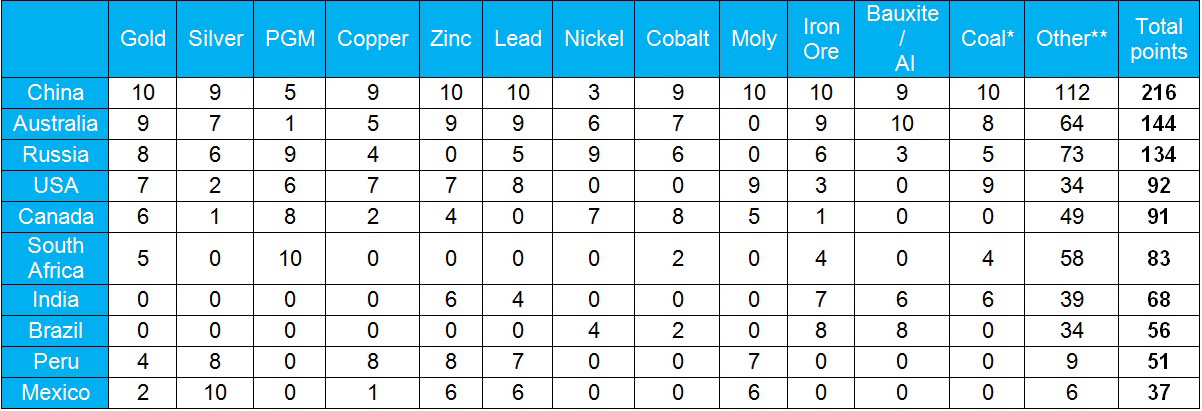
..The final outcome of this analysis is shown in the following table:
Countries – leaders in their domestic mine production. Results expressed in mining points
Table_mining_points-china216
Sources: USGS, BP, market reports, expert opinion.
*Estimation based on 2014 preliminary production figures, except coal and uranium, where 2013 totals used.
** Includes manganese, tin, tungsten, gem diamonds, potash, uranium and other commodities.
China holds first place with 216 mining points, overwhelmingly ahead of Australia, which sits second with 144 points – and 10 points behind third-ranked Russia. The United States and Canada, fourth and fifth in this ranking, are back-to-back with 92 and 91 mining points, respectively.
Of all commodities considered in this research, China is the leader in mining gold, zinc, lead, molybdenum, iron ore, coal, tin, tungsten, rare earths, graphite, vanadium, antimony and phosphate, and holds second place in mine production of copper, silver, cobalt, bauxite/alumina and manganese. The only two main produced commodities of which China is out of the top 10 are gem diamonds and chromium..

Montag, 16. März 2015

Barrick Gold: Potentieller Verkauf der großen Kupfermine in Chile

Um die Bilanz- und Finanzanlage zu entspannen, visiert Barrick Gold (NYE:ABX) vermutlich einen Verkauf der Kupfer-Flaggschiff-Mine Zaldivar in Chile an..

FT: Barrick Gold eyes sale of key Chilean copper mine 

Carl Surran, SA News Editor
  • Barrick Gold (NYSE:ABX) may put its Zaldivar copper mine in Chile up for sale, hoping to raise more than $1.5B, Financial Times reports.
  • A sale could draw interest from Chinese companies looking to acquire resources as well as P-E firms such as Mick Davis's X2 Resources, according to the report; Davis headed Xstrata before its 2012 sale to Glencore and is said to be hunting for mining deals.
  • The Zaldivar mine, one of ABX's key assets, is located next to Escondida, the world's largest copper mine.

Quelle: bigcharts.com

Dienstag, 30. September 2014

Spekulationen um goldgedeckten Yuan halten an: Basteln die Chinesen an einer neuen Weltleitwährung?

Neues aus der Gerüchteküche heute von ZH und Alan Greenspan:


Why Is China Hoarding Gold? Alan Greenspan Explains

Tyler Durden's picture


Remember when instead of pontificating on and explaining the consequences of three decades of devastating, ruinous, irresponsible Fed policies, and eagerly sharing ideas on how to "fix" these unfixable problems, Alan Greenspan was the primary culprit behind everything that is now wrong and broken with the world's financial system? Oh, and also was not an "Austrian" economist?
Good times.
Today we bring you the "other" Greenspan: the one who is blissfully unaware that, almost singlehandedly, he destroyed western capitalism, which is now living day to day, on borrowed time from one central bank printer to another. Ironically, the topic of his most recent Op-Ed for the Council of Foreign Relation's Foreign Affairs magazine, is none other than the default Kryptonite to every central banker, himself included if only a decade or so ago: gold.
And specifically the reason why, as we have covered consistently over the past 3 years, while the rest of the world is selling (if only paper gold), China just can't get enough of (physical) gold.
So for everyone curious what the world's most infamous central banker, probably of all time, thinks about China's gold hoarding ambitions, read on.
* * *
Why Beijing Is Buying
By Alan Greenspan, first posted in Foreign Affairs
If China were to convert a relatively modest part of its $4 trillion foreign exchange reserves into gold, the country’s currency could take on unexpected strength in today’s international financial system. It would be a gamble, of course, for China to use part of its reserves to buy enough gold bullion to displace the United States from its position as the world’s largest holder of monetary gold. (As of spring 2014, U.S. holdings amounted to $328 billion.) But the penalty for being wrong, in terms of lost interest and the cost of storage, would be modest. For the rest of the world, gold prices would certainly rise, but only during the period of accumulation. They would likely fall back once China reached its goal.
The broader issue -- a return to the gold standard in any form -- is nowhere on anybody’s horizon. It has few supporters in today’s virtually universal embrace of fiat currencies and floating exchange rates. Yet gold has special properties that no other currency, with the possible exception of silver, can claim. For more than two millennia, gold has had virtually unquestioned acceptance as payment. It has never required the credit guarantee of a third party. No questions are raised when gold or direct claims to gold are offered in payment of an obligation; it was the only form of payment, for example, that exporters to Germany would accept as World War II was drawing to a close. Today, the acceptance of fiat money -- currency not backed by an asset of intrinsic value -- rests on the credit guarantee of sovereign nations endowed with effective taxing power, a guarantee that in crisis conditions has not always matched the universal acceptability of gold.
If the dollar or any other fiat currency were universally acceptable at all times, central banks would see no need to hold any gold. The fact that they do indicates that such currencies are not a universal substitute. Of the 30 advanced countries that report to the International Monetary Fund, only four hold no gold as part of their reserve balances. Indeed, at market prices, the gold held by the central banks of developed economies was worth $762 billion as of December 31, 2013, comprising 10.3 percent of their overall reserve balances. (The IMF held an additional $117 billion.) If, in the words of the British economist John Maynard Keynes, gold were a “barbarous relic,” central banks around the world would not have so much of an asset whose rate of return, including storage costs, is negative.
There have been several cases where policymakers have contemplated selling off gold bullion. In 1976, for example, I participated, as chair of the Council of Economic Advisers, in a conversation in which then U.S. Treasury Secretary William Simon and then Federal Reserve Board Chair Arthur Burns met with President Gerald Ford to discuss Simon’s recommendation that the United States sell its 275 million ounces of gold and invest the proceeds in interest-earning assets. Whereas Simon, following the economist Milton Friedman’s view at that time, argued that gold no longer served any useful monetary purpose, Burns argued that gold was the ultimate crisis backstop to the dollar. The two advocates were unable to find common ground. In the end, Ford chose to do nothing. And to this day, the U.S. gold hoard has changed little, amounting to 261 million ounces.
I confronted the issue again as Fed chair in the 1990s, following a decline in the price of gold to under $300 an ounce. One of the periodic meetings of the G-10 governors was dedicated to the issue of the European members’ desire to pare their gold holdings. But they were aware that in competing with each other to sell, they could drive the price of gold down still further. They all agreed to an allocation arrangement of who would sell how much and when. Washington abstained. The arrangement was renewed in 2014. In a statement accompanying the announcement, the European Central Bank simply stated, “Gold remains an important element of global monetary reserves.”
Beijing, meanwhile, clearly has no ideological aversion to keeping gold. From 1980 to the end of 2002, Chinese authorities held on to nearly 13 million ounces. They boosted their holdings to 19 million ounces in December 2002, and to 34 million ounces in April 2009. At the end of 2013, China was the world’s fifth-largest sovereign holder of gold, behind only the United States (261 million ounces), Germany (109 million ounces), Italy (79 million ounces), and France (78 million ounces). The IMF had 90 million ounces.
However much gold China accumulates, though, a larger issue remains unresolved: whether free, unregulated capital markets can coexist with an authoritarian state. China has progressed a long way from the early initiatives of Chinese leader Deng Xiaoping. It is approaching the unthinkable goal of matching the United States in total GDP, even if only in terms of purchasing-power parity. But going forward, the large gains of recent years are going to become ever more difficult to sustain.
It thus seems unlikely that, in the years immediately ahead, China is going to be successful in vaulting over the United States technologically, more for political than economic reasons. A culture that is politically highly conformist leaves little room for unorthodox thinking. By definition, innovation requires stepping outside the bounds of conventional wisdom, which is always difficult in a society that inhibits freedom of speech and action.
To date, Beijing has been able to maintain a viable and largely politically stable society mainly because the political restraints of a one-party state have been offset by the degree to which the state is seen to provide economic growth and material wellbeing. But in the years ahead, that is less likely to be the case, as China’s growth rates slow and its competitive advantage narrows.


Donnerstag, 8. Mai 2014

Gold: China festigt den Spitzenplatz unter den Top-Produzenten

Die chinesische Gold-Produktion legte auch in 2013 weiter zu und erreichte einen neuen Rekordwert. So baut das Reich der Mitte seine Marktführerschaft im physischen Gold-Geschäft weiter aus.

China ist in den letzten 10 Jahren eindrucksvoll zum weltgrößten Konsumenten, Produzenten und Importeur von physischem Gold aufgestiegen. Weiter stehen alle Zeichen auf Wachstum und Expansion. Es scheint so, dass die Chinesen alles physische Gold, was sie nur bekommen können, mit allen Mitteln versuchen in das eigene Land zu bringen.

In 2013 erreichte in die inländische Goldminen-Produktion im Reich der Mitte einen neuen Rekordwert. Mehr als 420 Tonnen Gold (ca. 14,1 Mio. Goldunzen) wurden gefördert. So ergibt sich eine weitere 6%ige Steigerung der Gold-Förderung verglichen mit dem Vorjahr.

Der Abstand auf Australien, der zweitgrößte Gold-Produzente auf Landesebene weltweit, wird folgend noch größer. Er beträgt Ende 2013 bereits mehr als 5 Mio. Goldunzen, und die australische Goldminen-Produktion stieg in 2013 lediglich um 5% an.

Ansonsten konnten unter den 10 Top-Produzenten-Ländern nur wenige bedeutend die Gold-Förderung steigern. Russland schaffte jedoch ein 8%-Anstieg, Kanada glänzte mit einem Förder-Sprung von knapp 20%, was auf das Anlaufen und den erfolgreichen Ausbau von größeren Goldminen zurückzuführen war. Auch in Indonesien gab es ordentliche Steigerungen.

Die globale Gold-Produktion legte in 2013 nach den neusten Schätzungen und offiziellen Daten um rund 5% auf 96,73 Mio. Goldunzen zu. Es mehren sich die Stimmen, dass die Goldminen-Förderung das Peak erreicht hat bzw. der Förderhochstand bevor steht..


Top 10 der weltgrößten Goldproduzenten-Länder 2012/2013

Quelle: mineweb.com, metalsfocus.com


Quelle: ingoldwetrust.ch

Freitag, 20. Dezember 2013

Ausblick Gold- und Minen-Sektor 2014 - Video-Empfehlung: "The Chinese Don't Want Dollars Anymore, They Want Gold"

Nicht nur die Gold-Lager an der COMEX wurden/werden geräumt..
"The Chinese Don't Want Dollars Anymore, They Want Gold" - London's Gold Vaults Are Empty: This Is Why
Submitted by Tyler Durden on 12/19/2013 22:01 -0500
Today gold slid under $1200 per ounce, dropping to a level not seen in three years. Judging by the price action one would think that gold is not only overflowing from precious metal vaults everywhere, but can be found thrown away on the street, where nobody even bothers to pick it up. One would be wrong. In fact, as Bloomberg's Ken Goldman reports, "you could walk into a vault in London and they were packed to the rafter with gold, and the gold would trade from me to you to somebody else. You could walk into these vaults today and they are virtually empty. All that gold has been transferred out of London, 26 million ounces...." To find out where it has gone and why it is never coming back, watch the clip below (spoiler alert: listen for the line: "the Chinese don't want US dollars anymore, they want gold")..
Link: http://www.zerohedge.com/news/2013-12-19/chinese-dont-want-dollars-anymore-they-want-gold-londons-gold-vaults-are-empty-why